
Acoustic Neuroma Treatment in New York
Our New York vestibular schwannoma surgeons review your case as a team and prioritize the least invasive, effective treatment first.
What is vestibular schwannoma ?
A vestibular schwannoma is a benign growth on the hearing and balance nerve, not a brain or ear tumor. It develops from the nerve’s protective sheath between the inner ear and brainstem. Because hearing and balance fibers share a narrow bony channel, a small tumor can affect both functions.
Symptoms often lead people to an ENT or audiologist because an acoustic neuroma can resemble an ear condition. A nearby meningioma begins in the brain’s covering rather than the nerve. MRI and hearing tests distinguish them. Pinning down its size and position points to the right care.
See how it is treated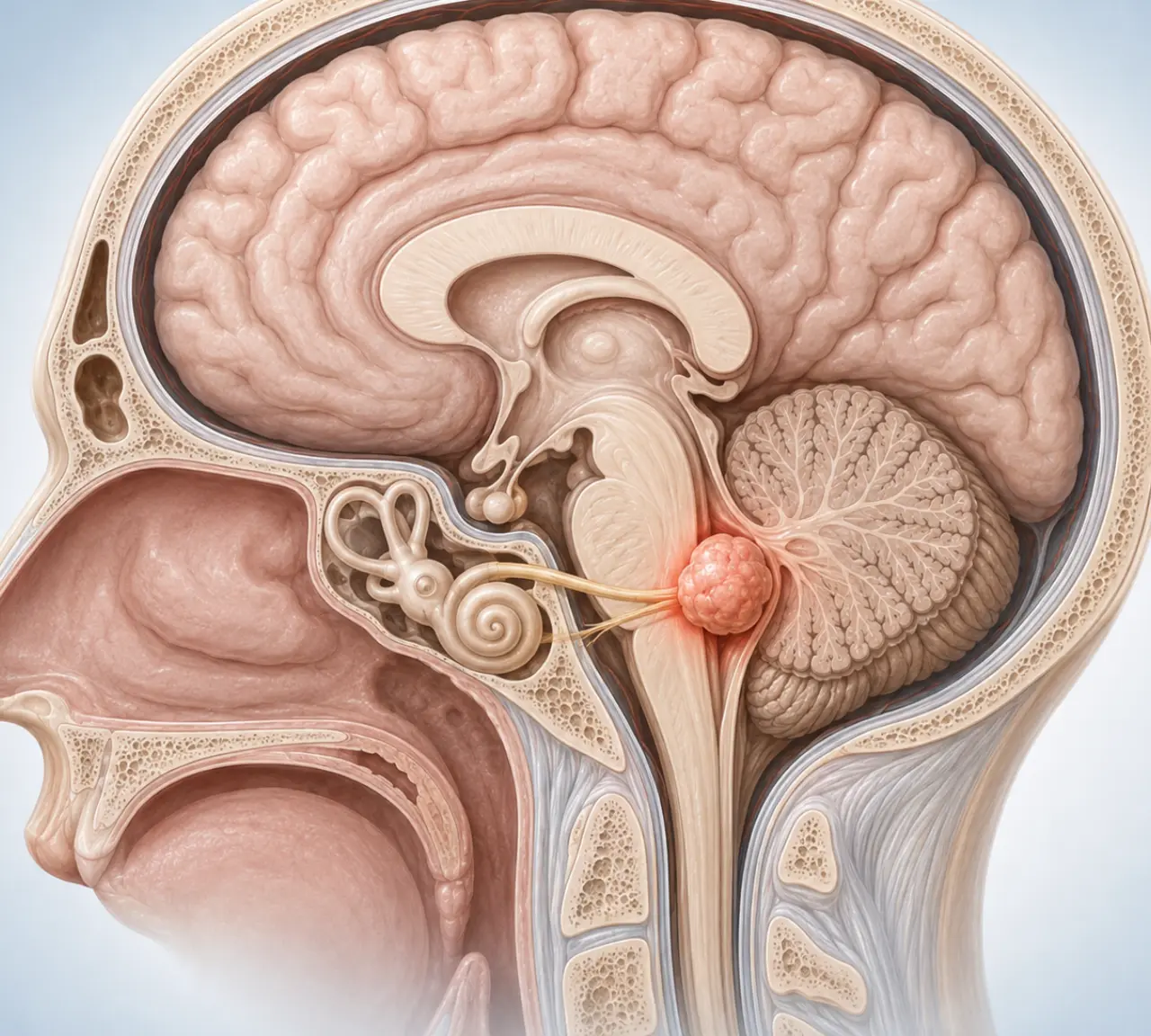
Vestibular schwannoma symptoms
The clue is that symptoms affect one ear, not both. These are the patterns we look for.

Hearing loss in one ear
Gradual hearing loss on one side, often noticed first on the phone or when following speech in a crowd.

Ringing in one ear
A steady ringing, buzzing, or hissing on the affected side that does not come and go like ordinary noise.

Unsteadiness rather than spinning
A sense of being slightly off balance, most noticeable in the dark or on uneven ground, rather than the room spinning.

Facial numbness, or sudden hearing loss
New facial numbness or weakness, or hearing that drops suddenly in one ear, should be checked immediately.
What causes a benign tumor on the hearing and balance nerve ?
Most vestibular schwannomas develop without an identifiable cause. Here are a few recognized risk factors worth reviewing.
Book an Appointment →-
01
A change in the nerve's insulating cells
A spontaneous change in the cells that wrap the nerve, with no identifiable trigger, explains nearly every case.
-
02
Neurofibromatosis type 2
This inherited condition can cause tumors on both hearing and balance nerves and needs dedicated evaluation.
-
03
Previous radiation to the head
Radiation to the head, usually given years earlier for another condition, is the one known environmental risk.
-
04
Not caused by mobile phones
Despite a common worry, there is no established link to mobile phone use and acoustic neuroma.
-
05
Regrowth after earlier treatment
A schwannoma can regrow after surgery or radiation, and repeat treatment near the facial nerve is demanding; we review these cases here in detail.

How is vestibular schwannoma diagnosed?
History and a hearing check
We ask about one-sided symptoms and your history, then arrange hearing and balance testing with audiology.
MRI and hearing tests
A contrast MRI is the test that finds even a tiny schwannoma and measures it exactly. Where the tumor is small and hearing is stable, we monitor with scheduled MRI and hearing tests rather than intervening, because many of these tumors grow slowly or not at all.
Reviewed by the full team
A neurosurgeon and an orthopaedic spine surgeon review the case together, alongside your hearing specialists, so nothing is evaluated in isolation.
Your options, laid out plainly
A schwannoma specialist explains monitoring, radiosurgery, and microsurgery, including how each may affect hearing, balance, facial movement, safety, and quality of life.
Vestibular schwannoma treatment, from conservative care to surgery
There are three top options: monitoring, radiosurgery, and surgery. The right choice depends on the tumor's size, your hearing, your age, and your symptoms.
Monitoring and focused care
Care matched to tumor behavior
- Scheduled MRI and hearing tests for a tumor that is not growing, sometimes for many years.
- Stereotactic radiosurgery to halt growth without an operation.
- Hearing aids or other hearing rehabilitation when hearing has dropped.
- Vestibular therapy for balance, walking, and return to daily activities.
Surgery, when it is needed
Our schwannoma surgeons choose the approach that protects the facial nerve
- Microsurgical removal through one of several approaches, chosen for the tumor’s size and position.
- Facial nerve monitoring throughout the operation to protect facial movement.
- Hearing preservation techniques when useful hearing remains.
- Repeat surgery or radiosurgery if the tumor regrows.

When it cannot wait: sudden facial weakness, worsening headache with drowsiness, or severe new imbalance with vomiting needs emergency care. Call 911 or go to the nearest emergency department. For sudden hearing loss in one ear, call 914-303-6548 the same day.
Doctors who treat Acoustic Neuroma (Vestibular Schwannoma) in New York
Across the New York metro area, our acoustic neuroma specialists bring academically trained neurosurgeons and orthopaedic spine surgeons together for one coordinated review.